
In this month's newsletter:
- AI Slop Report
- Operation Offsides
- State of the Fight
- TAG in the News
- Where in the world is TAG
- One More Thing
Joint TAG/ANA/Fiducia Analysis Provides First Estimate of Level of “AI Slop” in Digital Ad Supply Chain
Earlier this week, TAG and its partners at the ANA and Fiducia released the first statistically rigorous analysis of the level of “AI Slop” in programmatic media. Conducted as part of the Q1 2026 ANA Programmatic Transparency Benchmark, the analysis found that AI Slop accounts for between 1.3% and 2.4% of Open Web programmatic spend, on par with the industry’s 1.1% Made-for-Advertising (MFA) level.
Surprisingly, the analysis found that AI Slop outperformed clean inventory on conventional quality metrics, as AI Slop had an invalid traffic (IVT) rate of just 0.05% versus 0.32% for clean supply, it had higher viewability (77.2% versus 74.9%), and, after measurability was factored in, it graded as premium more than 70% of the time. Due to those high scores, AI Slop also commanded higher prices with a TrueCPM of $7.08 versus $6.15 for clean inventory.
Commenting on the results, TAG CEO Mike Zaneis said, “Definitions identify challenges, and data drives improvement. By defining and quantifying AI Slop for the first time, this analysis gives ad buyers a vital data framework to evaluate and improve their operations and results. TAG and its members have successfully used this same approach to address other endemic supply chain challenges like fraud and MFA, and this analysis serves as a vital first step in tackling AI Slop.”
Through engagement with supply chain quality vendors, the analysis helped establish an emerging consensus definition of “AI Slop” as low-value, mass-produced content generated primarily by AI for monetization with little or no human input, originality, or audience value.
The analysis noted that AI Slop has no demonstrable human fingerprint, and it fails to meet a premium content experience threshold. Vendors interviewed for the analysis described AI Slopt as "zero originality," "semantic shallowness," and "content that cannot demonstrate what the human author contributed."
Importantly, the defining characteristic for AI Slop was content quality, not the use of AI in content creation. Among the categories of content created with AI assistance that were not considered AI Slop are: AI-generated data summaries (like box scores or earnings recaps), AI-supported editorial content for which a human provides edits and original perspective, high-quality AI-native products (such as Character.AI), transparent AI content aggregators, and AI-enabled tools (like graphic design tools or organizers). No vendor defined AI Slop as simply being "AI-generated content."
Additional findings from the analysis included:
- Exposure to AI Slop is not uniform. - Across advertisers in the same dataset, AI Slop ranged from 0.11% to 13.84% of spend, with higher concentrations in long-tail inventory and certain exchange environments.
- Social media platforms are on the front lines. - Social media platforms are the primary and most rapidly growing AI Slop environment. While platforms are putting AI Slop policies and identification procedures in place, much work remains to be done, as one vendor estimated 25 to 40 percent of social video inventory is misaligned, with AI Slop a large and growing share.
- AI Slop is driven by templated domains. - The analysis found AI Slop could be identified through a 30.0% templated-site rate, which was 25 times the 1.2% rate of clean inventory. High viewability and low IVT rates on such template-driven domains offered a red flag for buyers about potential AI Slop. Known publishers, on the other hand, showed effectively zero AI Slop.
- AI Slop is overwhelmingly a long-tail phenomenon. - Roughly 1 in 27 impressions (3.7%) on unknown domains was classified as slop. Large, established exchanges ran single-digit rates, while smaller and native-format exchanges reached 4% to 8%.
- AI Slop follows classic “content farm” models - Across 11,552 “AI Slop” domains, the analysis found a predictable pattern of topics: parenting, travel, recipes, hairstyles, personal finance, and how-to content. Common types of content included fabricated viral stories, revenge fables, and engagement bait built on AI-generated imagery which were mass produced across near-identical domain templates and clone networks.
- Significant overlap exists between AI Slop and MFA content - Not surprisingly, given the structural similarities, the analysis found that a substantial 88% of AI Slop inventory also identified as MFA. The remaining 12% of AI Slop falls outside existing frameworks, escapes current tools, and costs more per verified impression than clean supply.
The analysis also offered recommendations to advertisers and agencies on the best ways to address AI Slop in their supply chains, including a review of IVT and viewability metrics with verification partners to determine whether they distinguish AI-generated content from AI Slop in a nuanced and accurate manner. Other recommendations included evaluating the risk of using smaller and native-format exchanges, given their higher rate of AI Slop, and examining their use of suppression lists and other tools to minimize long-tail risk from AI Slop.
For publishers and content producers, the analysis recommended broad transparency, responsible AI use, and independent validation of practices through independent certification, such as the AAM Ethical AI Certification.
The analysis used two complementary methodologies - domain-level classification from DeepSee and rendered page-level evaluation from Mobian - across the same underlying programmatic dataset to identify AI Slop. The analysis included domain level classification across $33.97 million in matched Open Web spend and rendered page level evaluation across 233 million URLs, 4.45 billion impressions, and $14.84 million in measured spend, with 30,000 plus page level evaluations and human verification of flags. The analysis was conducted and drafted by Scott Cunningham of Cunningham.tech Consulting.
A wide range of media outlets covered the AI Slop analysis, including Adweek, Business Insider, PPC Land, EMARKETER, and the AAM Blog.
US National IPR Center Highlights TAG Role in “Operation Offsides” Effort to Fight World Cup Pirates
As discussed in the last TAG Today, TAG recently took part in a groundbreaking collaboration with the US Department of Justice’s (DOJ) National Intellectual Property Rights Center (IPR Center) to shut down and demonetize websites that were profiting from illegal streaming content during the 2026 FIFA World Cup.
While the DOJ shut down hundreds of pirate websites through the legal system, TAG led a parallel effort to demonetize more than 1,300 more by adding the sites to its Pirate Domain Exclusion List (PDEL), so its supply chain partners could stop the flow of money to the criminals running them.
As the games came to a close this month, the IPR Center shined a post-event spotlight on that effort by sharing a summary of the collaboration by TAG COO Rachel Nyswander Thomas through its LinkedIn social media channel.
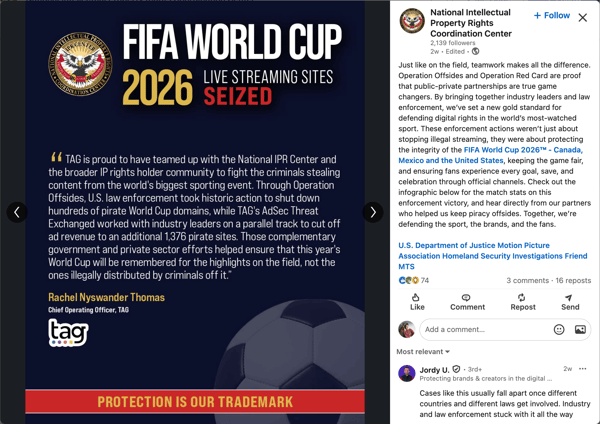
In Rachel’s words, "TAG is proud to have teamed up with the National IPR Center and the broader IP rights holder community to fight the criminals stealing content from the world's biggest sporting event. Through Operation Offsides, U.S. law enforcement took historic action to shut down hundreds of pirate World Cup domains, while TAG's AdSec Threat Exchange worked with industry leaders on a parallel track to cut off ad revenue to an additional 1,376 pirate sites. Those complementary government and private sector efforts helped ensure that this year's World Cup will be remembered for the highlights on the field, not the ones illegally distributed by criminals off it."
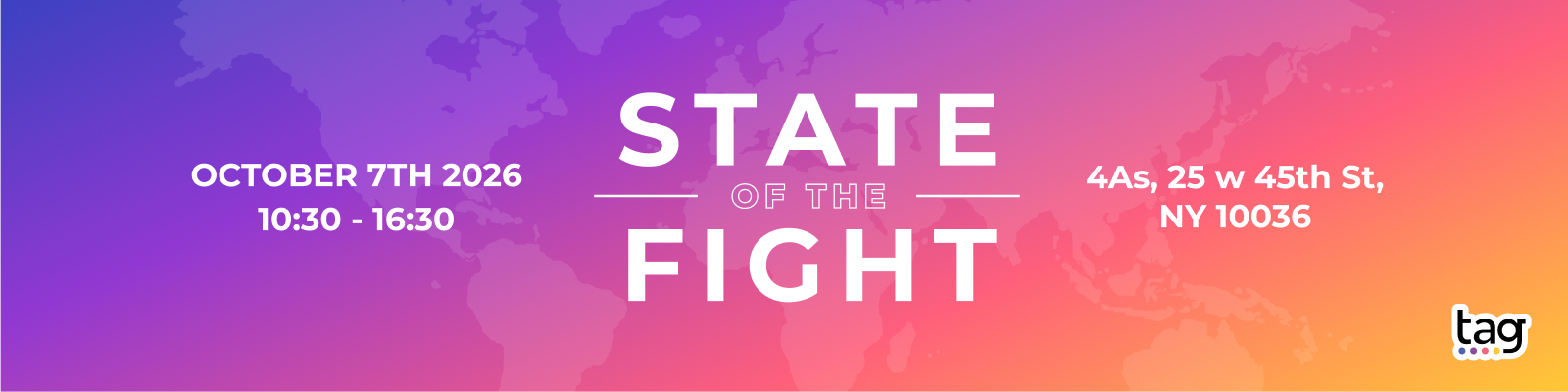
SAVE THE DATE: TAG “State of the Fight” in NYC on October 7, 2026!
The industry's biggest challenges won't solve themselves - State of the Fight coming back to NYC in October!
Shaped by the priorities of the TAG community, the programme zeroes in on the threats, trends, and opportunities defining digital advertising today. Expect candid discussions, standout speakers, and practical takeaways you can actually use.
No recycled presentations. No generic keynotes. Just the conversations that challenge thinking, spark collaboration, and move the industry forward.
Book your ticket now! tagtoday.net/state-of-the-fight. (Password in Member's inboxes!)
.png?width=2500&height=500&name=IN%20THE%20NEWS%20(Flip).png)
From “AI Slop Is Fooling Advertisers’ Verification Tools” in Adweek:
AI-generated content—cheap, mass-produced pages built primarily to harvest ad dollars, known as slop—is passing quality checks advertisers have relied on to avoid junk inventory, according to a report published Tuesday by Trustworthy Accountability Group (TAG), the Association of National Advertisers (ANA), and data partner Fiducia. …
“There could be billions of dollars at stake here going to low-quality AI slop websites,” Mike Zaneis, CEO, TAG told ADWEEK, though he cautioned TAG has not yet estimated actual ad spend on the sites it identified. …
In the case of MFA, sites have been engineered to win as many cheap programmatic auctions as possible, regardless of whether anyone was reading them. That rapid-fire bidding behavior from MFA sites tipped off verification vendors to the problem.
AI slop operators appear to have learned from that mistake and, rather than flooding auctions with lowball bids, Zaneis said, they build sites designed to stay under specific thresholds that would get them flagged, sailing through the metrics vendors already screen for.
From “Now That’s What I Call an Insight” in Business Insider:
“AI slop looks like legitimate inventory in the same way a fake Hermès bag looks at first glance like a real one,” Mike Zaneis, CEO of TAG, told me.
The purveyors of AI slop have figured out how to fool the systems that many marketers use to weed out low-quality publishers.
Zaneis said that’s why marketers should shift their measurement strategies away from relying on single metrics, such as viewability, to using mixed models.
From “The DOJ Just Shut Down Nearly 400 Illegal World Cup Streaming Sites” in Vice:
The crackdown, dubbed Operation Offsides, is being led by the DOJ’s National Intellectual Property Rights Coordination Center with help from Homeland Security Investigations, a squad of international prosecutors, and private companies including FIFA, NBCUniversal, Warner Bros., UFC, and beIN Media Group. …
Governments and corporations have paired up to attack these sites with a one-two punch that involves taking some sites down and merely choking out the advertising revenue of some others. The latter is spearheaded by Trustworthy Accountability Group, or TAG. …. It’s a nonprofit backed by the digital advertising industry that says it has identified and demonetized 1,373 domains of piracy sites.
From “1,376 World Cup Piracy Sites Are Targeted by TAG and the DOJ to Protect Ad Budgets” in EMARKETER:
TAG’s real-time countermeasure provided support to federal anti-piracy efforts; under “Operation Offsides,” the US Department of Justice seized 400 pirate domains that, while sharing common sources, remain distinct from the 1,376 domains targeted by TAG’s financial blockade.
Anti-piracy procedures optimized during the World Cup will likely scale across other high-visibility sporting events where streaming rights command premium fees; EMARKETER forecasts $1 billion in converged TV ad revenues for the 2027 Super Bowl and more than $2 billion for the 2028 Olympics, underscoring the financial interest in blocking pirates. …
For advertisers and agencies, growing anti-piracy initiatives are a critical safeguard for brand safety and media efficiency. Programmatic advertising runs the risk of accidental placement on illicit sites, which compromises brand equity, and also takes away attention from expensive live ad placements.
By implementing TAG’s updated exclusion lists, marketers ensure that ad spend is directed toward legitimate, brand-appropriate media environments. This reduces ad waste, improves conversion accuracy, and ensures that marketing investments drive authentic consumer engagement.

Team TAG are always looking to connect with the TAG Community wherever they are! In 2026, are planning to be at the following events:
ANA AI & Tech Conference
September 23th - 25th
Maryland, US
Advertising Week NYC
October 5th - 8th
New York City, US
ANA Masters of Marketing
October 20th
Orlando (Florida), US
Keep up-to-date with TAG's event calendar 👉 tagtoday.net/events
 Keep Up-To-Date With The Working Group Brief
TAG's working groups are a crucial source point of conversation and collaboration for digital advertising. Make sure you stay up to date with the latest progress and developments with the Workin Group Brief.
Read the latest Working Group Brief 👉 tagtoday.net/working-groups
 Leverage TAG Research into Your Everyday!
From APAC Fraud Snapshot reports, to UK Brand Safety Consumer reports, to Best Practices whitepapers, TAG's research is here to support our member's day-to-day compliance as well as strategic planning.
Visit our Data and Insight page 👉 tagtoday.net/insights
 Let's Make Some Noise Together 🤝
We love it when TAG members highlight our work together to fight digital ad crime and improve transparency. Please send any TAG-related press releases, blogs, or other announcements to Andrew Weinstein at andrewwstn@gmail.com for review before release.
Topics: Blog
